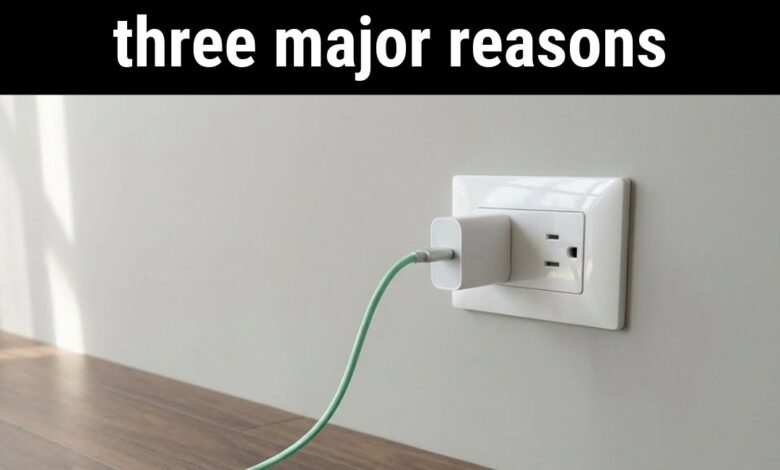
The modern home is a silent labyrinth of electrical currents, a web of connectivity that hums beneath the surface of our daily lives. At the heart of this network sits the humble wall charger—a small, unassuming plastic block that we interact with dozens of times a day. We plug it in, tether our lives to it for an hour or two, and then walk away, often leaving the charger itself behind. It seems harmless, a dormant tool waiting for its next assignment. However, this common habit carries hidden costs that span from personal safety and device longevity to global environmental impact. Understanding the “phantom” life of a charger is the first step toward more mindful energy consumption.
When a charger remains plugged into an outlet without a device attached, it enters a state known as “no-load” power consumption. While it may appear inactive, the internal transformer is still completing a circuit. This phenomenon is often called “vampire energy” or “phantom load.” The charger is essentially “sipping” electricity, converting high-voltage alternating current (AC) from your home’s wiring into the low-voltage direct current (DC) your phone requires, even if there is no battery to receive it.
The amount of energy a single charger consumes in this state is undeniably small—often less than half a watt. For an individual household, the cost reflected on a monthly utility bill might be mere pennies. This insignificance is exactly why the habit is so easy to ignore. However, when we zoom out to a global perspective, the math changes dramatically. In a world with billions of smartphones, tablets, and laptops, these “teasingly small” trickles of energy aggregate into a massive, unnecessary demand on the global power grid. This wasted electricity must be generated somewhere, often through the burning of fossil fuels, contributing to carbon emissions for a service that provides zero utility.
Beyond the environmental footprint, there is the matter of the charger’s own physical health. Every electronic component has a finite lifespan, and that lifespan is dictated largely by two factors: time and heat. Even in a no-load state, the components inside a charger generate a small amount of heat as electricity flows through them. Over months and years, this constant thermal stress can take a toll.
The capacitors—small components that store and release energy—are particularly sensitive to constant power. When a charger is left plugged in indefinitely, these parts age prematurely. The insulation around the internal wiring can become brittle, and the soldered joints that hold the circuit together can weaken over time. While a high-quality, manufacturer-certified charger is designed with safety margins to handle this, the same cannot be said for the “knockoff” or third-party adapters that have flooded the market. These cheaper alternatives often cut corners on internal shielding and thermal protection, significantly increasing the risk of a component failure.
This leads to the most critical, albeit rare, concern: fire safety. While the likelihood of a brand-name charger spontaneously combusting is extremely low, the risk is never zero. The danger often lies at the intersection of a degraded charger and a faulty environment. A loose wall outlet, a frayed charging cable, or a crowded power strip can create the perfect conditions for an electrical arc or overheating.
Power strips are a particular point of vulnerability in the “always-on” home. We tend to treat them as infinite expansion slots for our digital needs, plugging in lamps, gaming consoles, and multiple chargers without considering the total load. A power strip that is constantly burdened by multiple “vampire” devices remains warm to the touch, which can degrade the strip’s internal breakers and surge protection over time. By simply unplugging a charger when it isn’t in use, you remove a potential point of failure from your home’s electrical ecosystem.
The habit of leaving chargers plugged in also affects the mechanical integrity of our living spaces. Constantly tugging on a cable that is still connected to a wall can loosen the internal contact points of the outlet. Over time, this creates “arc faults,” where electricity jumps across small gaps, creating intense heat. By practicing the habit of fully disconnecting the device and the charger, we tend to be more deliberate with our movements, reducing the physical wear and tear on the hardware that keeps our homes powered.
There is also a psychological dimension to this practice. We live in an age of “passive consumption,” where our devices and appliances are designed to be ready at a moment’s notice. This convenience is addictive, but it can also lead to a sense of powerlessness. We feel like passengers in a world wired to stay “always on.” Taking the half-second to pull a plug from a wall is a small act of reclamation. It is a conscious decision to end a cycle of waste. It transforms a mindless routine into a moment of environmental and personal stewardship.
The transition to a more mindful home doesn’t require a radical lifestyle overhaul. It can begin with simple “smart” interventions. For those who find it difficult to remember to unplug every individual device, the use of power strips with individual on/off switches or “smart plugs” can automate the process. These tools allow you to cut the flow of electricity to an entire charging station with a single click or a scheduled timer, eliminating phantom loads without the need to physically reach behind furniture every night.
Ultimately, the story of the lonely charger in the wall is a metaphor for the many small, overlooked habits that define our modern existence. We often wait for a “catastrophe” to change our behavior, ignoring the “mild trickle” of waste that occurs in the absence of a crisis. But sustainability and safety are rarely the result of one big, dramatic action; they are the cumulative result of a thousand tiny, correct choices.
By unplugging that charger, you are doing more than just saving a fraction of a cent or extending the life of a capacitor. You are participating in a global movement toward efficiency. You are acknowledging that fresh water, clean air, and the energy that powers our world are precious resources that deserve our attention, even in the smallest of doses. It is a simple act that yields a sense of control in a hyper-connected world, proving that sometimes, the most meaningful changes start with a simple pull of a cord.